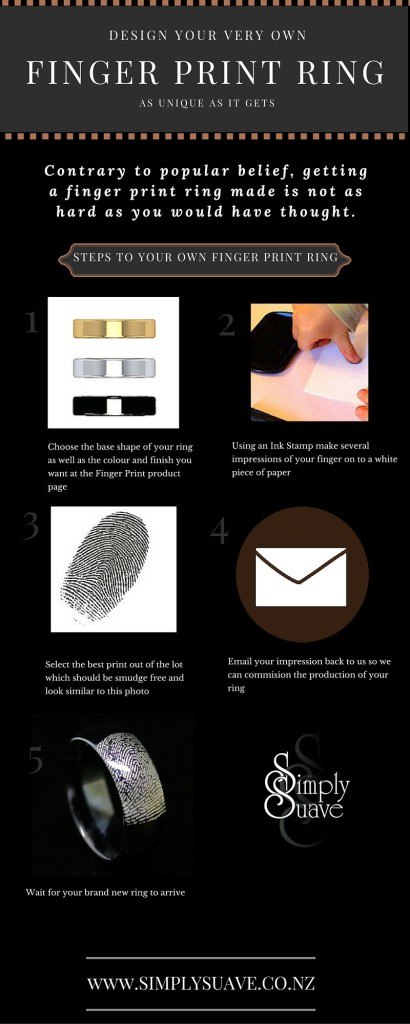
Finger Print Rings have grown in popularity recently due to the fact that they are a fast and way to personalise your ring without too much effort. We elaborate the process of getting a custom made finger print ring as below
Decide on the Base Shape that you want for the ring. Example of base shapes are classic dome, step edge, pipe cut, and so on.
Decide on the colour.
Decide on the polish/finish of the ring. You now need to decide whether you would like a polished( shiny) or brushed( matt) finish for your ring.
Decide on the finger print you need( Most common ones are the right hand index or left hand ring finger impression)
Create your finger print Impression by using an ink stamp( recommended) or by covering your finger with a blob of ink and making several impression on to a clean white piece of paper.
Choose the one that is clearest and without smudges as your print.
Choose your ring size. Add Engraving if required. All done from your end. Now just relax and wait for your ring to arrive.
You may also check out the whole range of mens rings here.
In the 1920s, well before diamonds become “forever,” jewelers attempted to popularize engagement rings for men (Zabell 2014). From the jewelers’ perspective, men wearing engagement rings would double their sales—a clear economic boon.
But despite manly names for the rings and ads featuring men holding cigarettes while sporting precious gems, the campaign made little progress. Perhaps the traditional connotation of the engagement ring as an "insurance plan" for later-jilted women—who may have lost their virginity and, for many at that time in history, much of their marriageability prospects post-engagement (Rupp 2013)—was too ingrained for couples to comprehend the sense of a male engagement ring.
Fast-forward to the 21st century when, while a gendered double standard of sexuality still remains strong, virginity is no longer a prerequisite for most women’s marriageability—and a broken engagement is far less of a stigma as well. The historic meaning of the engagement ring has been all but forgotten—many prospective grooms may buy a diamond ring without questioning why diamonds are the default or why we expect this bling to accompany proposals (Friedman 2015). Although more women do so today, there remains a strong societal norm for men to propose (Marcotte 2012); in general, women have made fewer advances toward equality in the private realms of love and family than they have in employment (England 2010).
However, expectations may be slowly changing.
A survey by The Knot suggests that 5% of newly-engaged men are advertising their “taken” status with manly bling (Zabell 2014). Some jewelers are explicitly retailing engagement rings for men—albeit generally much less expensive than those for women and sporting only a small diamond (Zabell 2014). Male celebrities, including Johnny Depp and Charlie Sheen, may be popularizing the trend (Fogarty 2014). In addition, jewelers report, gay men opt for diamond rings more often than straight men (Zabell 2014), breaking down some gendered expectations while opening new markets.
It is also possible that women’s increasing earning power is changing the gendered financial norms of courtship, updating expectations regarding the one-way gift of an expensive ring. In any case, as men in diamond rings become more common, even more males may decide that they also yearn for a bit of bling on their finger.
Notwithstanding the problematic gendered history of female engagement rings (Rupp 2013) and the commercially invented nature of the diamond ring “tradition” in the first place (Friedman 2015), the "mangagement ring" is potentially a promisingly-egalitarian trend. Certainly, the merit of expressing our love by buying overpriced diamonds can be debated (Friedman 2015; Rupp 2013). But since it doesn’t seem that most women are likely to forego engagement rings anytime soon, the best bet for gender-egalitarian engagements may be to encourage men to start wearing rings too. Perhaps the mangagement ring can begin to erode the gendered double standards around proposals—and the related stereotypes that women want marriage more than men do. Such stereotypes are certainly inaccurate